
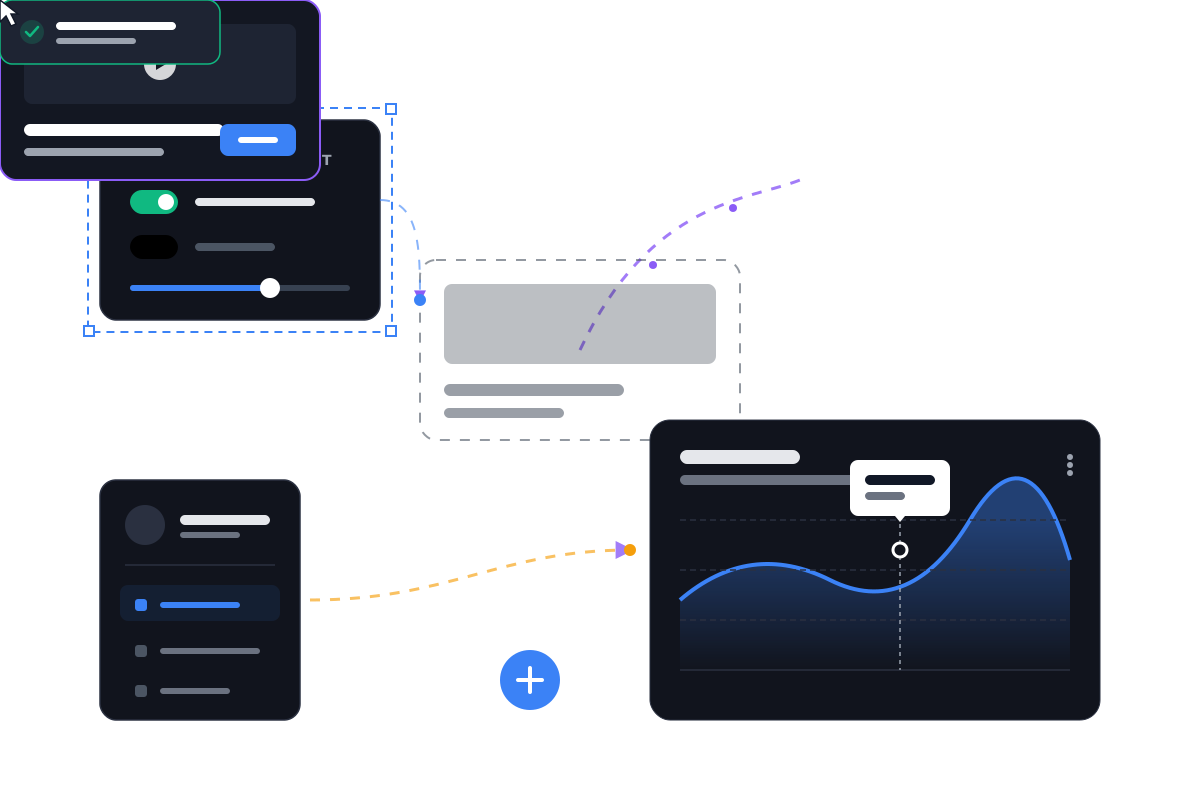

Design that converts visitors into customers — not just looks good
Mayurasoft designs interfaces grounded in user research and business data. Every pixel earns its place by serving a measurable outcome — lower bounce rates, higher conversions, faster time-to-value.
Is this you?
Six UX problems costing you customers every day
Three or more of these describe your product? You're already leaving measurable revenue on the table — and it compounds every quarter without a design investment.
Users drop off without saying why
Your analytics show traffic but your conversion rate flatlines. Sessions end mid-flow and heatmaps show clicks on non-clickable elements — a classic UX diagnosis hiding in plain sight.
Conversion riskSupport tickets are UX complaints
"How do I find X?" "Where does Y go?" When users raise tickets for navigation questions, the interface has failed. Every support interaction is a UX cost your team is absorbing silently.
Efficiency drainEvery new feature slows the product down
No design system means every feature gets custom-built from scratch. Inconsistent components multiply technical debt and increase QA time. Onboarding new engineers takes longer with every sprint.
Delivery bottleneckEnterprise buyers reject on UX maturity
B2B procurement evaluates your product's interface as a proxy for engineering quality. A dated or inconsistent UI signals risk. Deals are lost before the demo ends — and you won't know why.
Revenue riskNo design system — devs rebuild everything
Without a component library, developers implement the same button five different ways across five screens. Inconsistency erodes trust. Visual debt compounds until a full redesign becomes inevitable.
Quality riskDesign and dev conflict every sprint
Vague wireframes, missing edge cases, and last-minute design changes create friction between designers and developers. Without annotated specs and a shared system, every handoff becomes a negotiation.
Org riskRecognise three or more? — A free design audit gives you a concrete, prioritised action plan within 48 hours. No sales call required.
Methodology
Design Lifecycle
No guesswork. A research-led, six-stage process that turns ambiguity into a tested, dev-ready design system.
Stakeholder alignment & user research
We run structured stakeholder workshops and user interviews to understand goals, pain points, and context. Competitive UX audits surface opportunities before a single pixel is placed.
Personas, JTBD & design brief
We synthesise research into 2–4 primary personas and jobs-to-be-done maps. The output is a signed-off design brief that anchors every subsequent decision.
IA, user flows & lo-fi wireframes
Information architecture and user journey maps come first, then lo-fi wireframes for every key screen. A stakeholder review closes the stage before we add fidelity.
Hi-fi prototype & micro-interactions
We build a clickable hi-fi prototype in Figma with micro-interaction specs, edge cases, and error states — enough fidelity to test with real users.
Moderated usability & iteration
Moderated sessions, heatmaps, and session recordings surface priority issues. We iterate the designs post-testing before handing off to development.
Dev-ready specs & design system
We deliver dev-ready Figma files with full annotations, a component library, and design token exports. A live walkthrough with your engineering team ensures zero translation loss.
Tools & Platforms
Technologies We Work On
Mayurasoft delivers exceptional design experiences through constant innovation by using cutting-edge, industry-standard design tools.
Adobe XD

Sketch
Figma

Canva
Our philosophy
Six principles every Mayurasoft design is held against
These aren't aspirational values — they're the criteria we use to evaluate every design decision before it leaves our studio.
Users first, aesthetics second
Beautiful design that confuses users is bad design. Every decision starts with "does this make the user's task easier?" If the answer is no, the design changes.
Design with data, not assumptions
We conduct research before we design. Heatmaps, session recordings, and user interviews inform every wireframe — not gut feel.
Accessibility is non-negotiable
WCAG 2.1 AA compliance is a baseline, not a checkbox. Contrast, keyboard navigation, and screen reader support are built in from day one.
Consistency creates confidence
Design systems over one-off screens. A coherent visual language reduces cognitive load and builds trust.
Test before you build
A usability test on a wireframe costs a fraction of fixing the same problem in production. We validate every design with real users before it goes to development.
Design for the developer handoff
Pixel-perfect specs, component documentation, and annotated Figma files. Developers never have to guess the intent behind a design decision.
Why invest in design
What happens when design is an afterthought
The cost of skipping UX investment isn't zero — it shows up as rework, churn, and lost deals. Here's what the data says.
of sprint time wasted fixing UX issues after launch
UX bugs — caught in prototype before a single line is written
support ticket volume and slow time-to-value for new users
fewer onboarding support tickets with intuitive user flows
industry average — where most teams without UX investment land
above industry baseline with research-led design decisions
constant mid-sprint back-and-forth clarifying design intent
annotated specs, design system, component library — zero ambiguity
poor UX is a consistent deal-breaker in B2B procurement
polished UI signals product maturity to enterprise buyers
Source: Forrester Research, Nielsen Norman Group, Baymard Institute. Figures represent industry medians across B2B SaaS products.
How We Engage
Choose Your Best Plan
Start with a free design audit — we'll tell you which model fits your situation before any commitment is made on either side.
You're building something new
Best for: New products, greenfield featuresFor teams building a new product or feature set that needs a complete UX/UI foundation before development begins.
- User research & persona development
- Information architecture & user flows
- Lo-fi wireframes → hi-fi screens
- Usability testing & iteration
- Full design system & developer handoff
Your product needs a UX overhaul
Best for: Existing products with friction or churnFor existing products where UX is creating friction, churn, or a measurable support burden you want to reduce.
- UX audit with heuristic evaluation
- User interviews & session analysis
- Priority flow redesigns
- A/B test-ready design variants
- Conversion rate optimisation
You need continuous design velocity
Best for: Product teams, design-dev alignmentA dedicated designer embedded in your team — working alongside your developers sprint by sprint, owning the design system.
- Sprint-aligned design delivery
- Design system ownership & evolution
- Weekly design review sessions
- Continuous usability testing
- Direct collaboration with your devs
Common questions
What clients ask before starting a design engagement
Not seeing what you need? Book a 30-minute discovery call — we'll answer everything specific to your project.
No — and we'd actually encourage starting design before development. Having validated, tested designs before development begins prevents the costly UX rework that happens when developers build from requirements alone. We can start as soon as you have a brief and a stakeholder to collaborate with.
We design in Figma — the industry standard for collaborative UI design. You get full access to the live Figma file throughout the engagement, not just at the end. All source files transfer to you completely at handoff. We also provide Figma Dev Mode specs so your developers have everything they need without re-measuring pixels.
Each design phase includes structured feedback rounds with a clear process: we present, you consolidate feedback internally, and we iterate. We agree the number of revision rounds upfront in the scope document — typically two rounds per major phase. This prevents the endless revision loop that plagues engagements without process discipline.
Yes — and we recommend it. Designing for both surfaces in parallel ensures a consistent design system rather than mobile being retrofitted from web screens. We use responsive design principles and component-based systems that scale across breakpoints from the start.
The most valuable input comes at the beginning and at review gates — not day-to-day. We run a kickoff workshop, then work independently with regular check-ins (typically weekly). We need a single point of contact on your side who can consolidate stakeholder feedback. Beyond that, we keep the process from becoming a calendar burden for your team.
Your users are telling you something. Let's find out what.
A free design audit takes 48 hours and tells you the top three UX issues costing you conversions or retention right now — with specific recommendations, not generic advice.


